Understanding K-Factor Transformers: How to Handle Non-Linear Loads in Industrial Power
What a K-factor rating really means, why non-linear loads overheat ordinary transformers, and how to pick the right unit for drives, UPS, and electronics-heavy facilities.
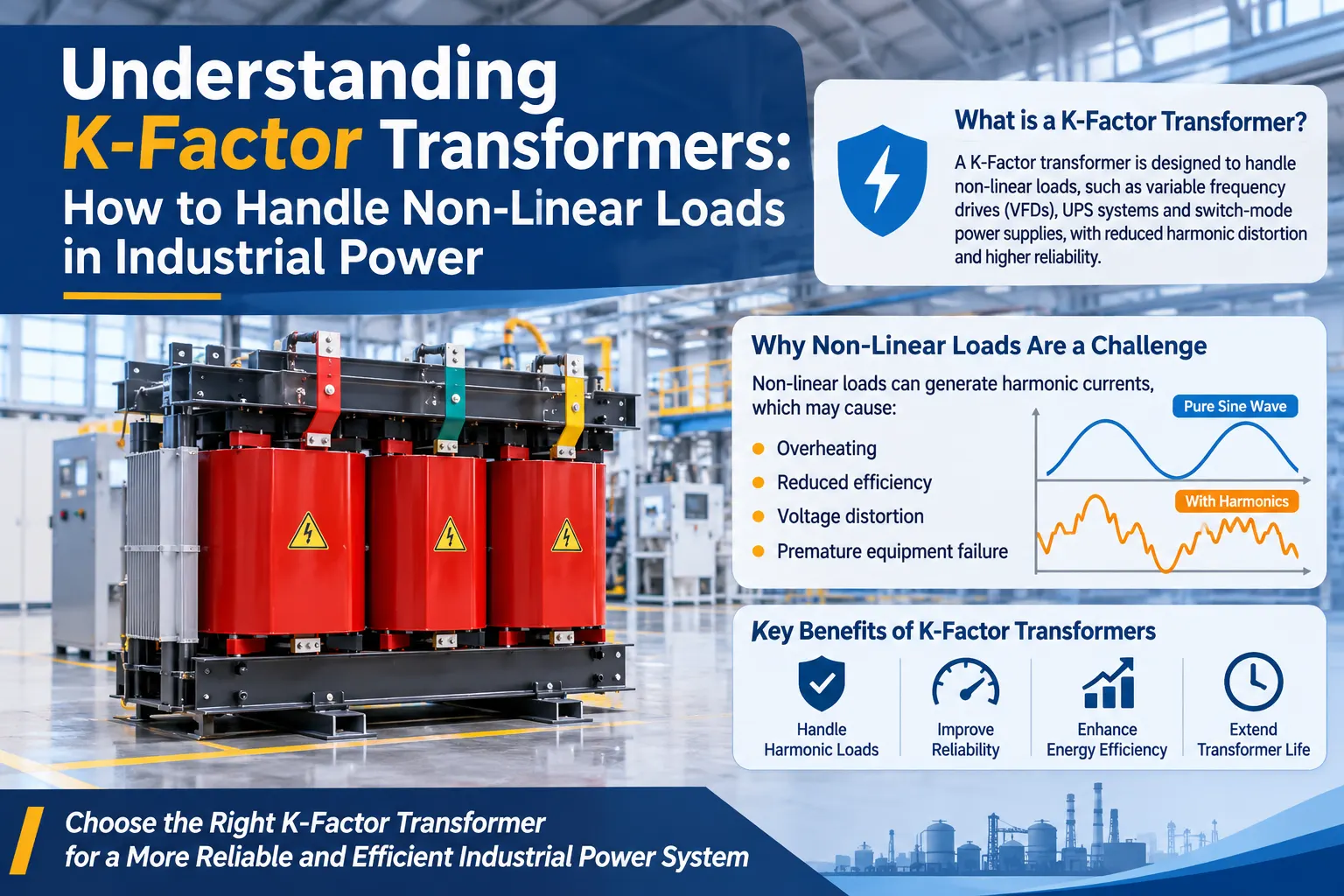
A K-factor transformer is a transformer built to supply non-linear loads — equipment that draws current in sharp pulses and generates harmonics — without overheating. The K-factor is a number (K-4, K-13, K-20, K-30, and so on) that rates how much harmonic heating a transformer can absorb. A higher K-factor means a greater tolerance for harmonic-rich loads. In practice: match the K-rating to the load mix, oversize the neutral for single-phase electronics, and derate or replace any standard transformer that is running hot under non-linear load.
Linear versus non-linear loads
A linear load — a motor, a heater, an incandescent lamp — draws current in a smooth sine wave that follows the voltage. Transformers have been built for that world for a century. The modern industrial plant no longer lives in it.
Variable-frequency drives, servers, UPS systems, LED lighting, rectifiers, and switch-mode power supplies are non-linear: they pull current in short, sharp bursts rather than a smooth wave. Those bursts are the sum of the fundamental 50/60 Hz current plus a family of higher-frequency currents called harmonics. The load looks ordinary on a basic meter, yet the current flowing through the transformer is distorted — and that distortion is where the heat comes from.
Why harmonics overheat an ordinary transformer
Harmonics punish a transformer in three specific ways, and understanding them is the whole reason the K-factor exists.
Eddy-current losses rise with the square of frequency
Stray magnetic fields induce small circulating currents in the windings. These eddy-current losses grow roughly with the square of the harmonic frequency, so a 5th or 7th harmonic heats the winding far more than its current alone would suggest. This is the dominant overheating mechanism under non-linear load.
The neutral can carry more current than the phases
In three-phase systems feeding single-phase electronics, the triplen harmonics (3rd, 9th, 15th) do not cancel in the neutral — they add. The neutral conductor can end up carrying more current than any phase, overloading a conductor that was never sized for it.
Hidden heat ages the insulation
Because a basic RMS meter understates harmonic heating, a standard transformer can run well over its real thermal limit while appearing lightly loaded. The insulation ages quietly, and the first visible symptom is often a failure rather than a warning.
What a K-factor transformer actually is
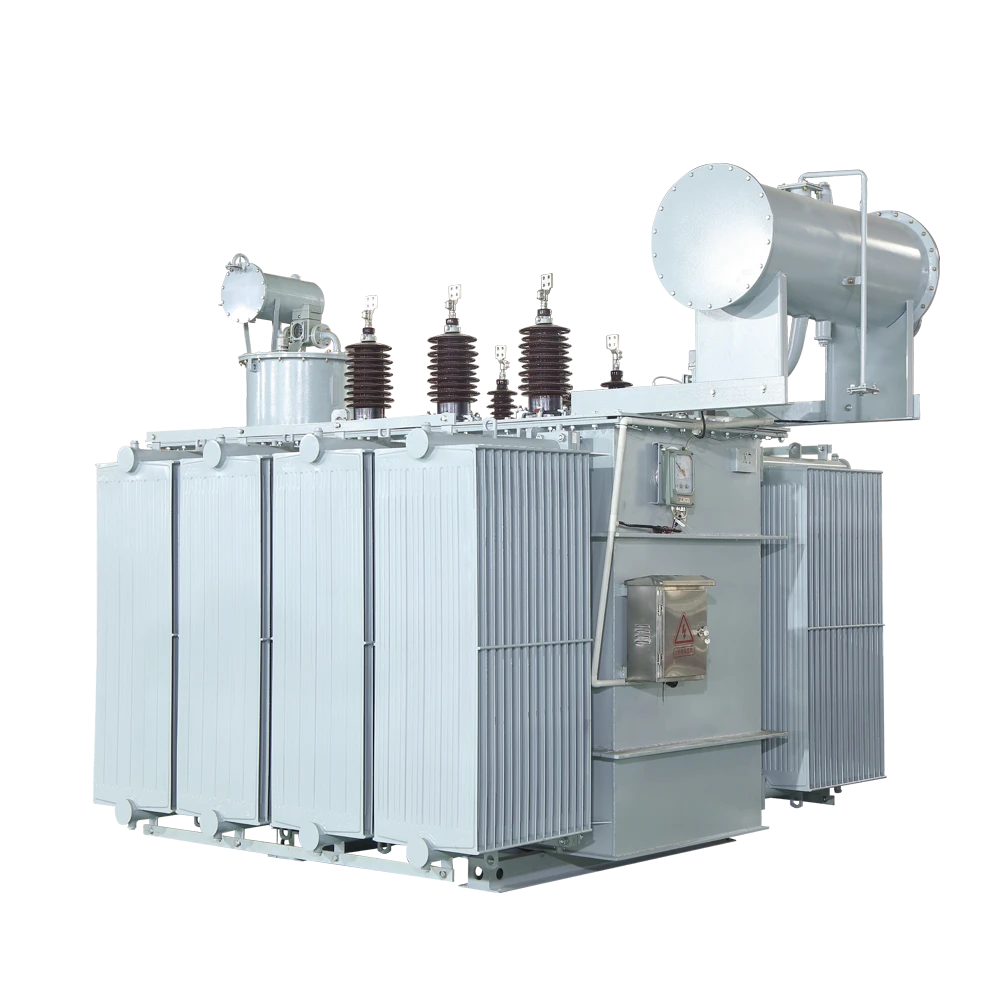
A K-factor transformer is not a filter and it does not remove harmonics. It is a transformer engineered to carry harmonic-rich current and dissipate the extra heat safely. The K-rating on the nameplate tells you how much harmonic loading it was designed to withstand while staying within its temperature limit.
Put simply: a standard transformer is a K-1. A K-13 is built to tolerate the harmonic heating of a heavily non-linear load; a K-20 or K-30, more still. Choosing a K-factor is choosing a thermal safety margin matched to the electronics your facility runs.
How the K-factor is calculated
The K-factor is a weighted sum of the harmonic currents, with each harmonic weighted by the square of its order — exactly because eddy-current heating scales with frequency squared. The standard definition is:
K = Σ ( Ih2 × h2 ) ÷ Σ Ih2
where Ih is the per-unit current at harmonic order hThe key takeaway is not the arithmetic but the behaviour it captures: higher-order harmonics carry disproportionate weight. A modest amount of high-order harmonic current can drive the K-factor up quickly, which is why electronics-dense facilities need far more margin than their basic load reading implies.
K-factor ratings and the loads they suit
K-ratings are standardised steps. This table maps each common rating to the kind of facility it is built for — use it as a first-pass selection guide.
| K-rating | Harmonic load level | Typical environment | Non-linear share |
|---|---|---|---|
| K-1 | None (standard) | Motors, heaters, resistive loads | Minimal |
| K-4 | Light | Mixed load with some drives or lighting | Low |
| K-13 | Moderate | Schools, offices, retail, telecom rooms | Medium |
| K-20 | Heavy | Data-adjacent areas, healthcare, many VFDs | High |
| K-30 / K-40 | Very heavy | Data centers, large UPS plants, industrial rectifiers | Very high |
How to choose the right K-factor
Over-specifying wastes capital; under-specifying invites the overheating the transformer was meant to prevent. Work through these steps in order.
-
Inventory the load
List what the transformer will feed and estimate how much of it is non-linear — drives, UPS, computers, LED, rectifiers. The ratio of non-linear to linear load is the single biggest driver of the K-rating you need.
-
Measure, don't guess, where you can
On an existing site, a power-quality meter can read the actual harmonic spectrum and compute the real K-factor. On a new design, estimate from the equipment schedule and lean toward the higher standard step.
-
Match to the next standard step up
Select the standard K-rating at or just above your calculated figure. A light mix suits K-4; general commercial electronics suit K-13; drive- or UPS-heavy plants move to K-20 and above.
-
Size the neutral for triplen harmonics
For three-phase feeds to single-phase electronics, specify an oversized (often double) neutral so the additive triplen harmonics have a conductor sized to carry them.
-
Decide: K-factor unit, or derate a standard one
A purpose-built K-factor transformer is the clean answer for sustained non-linear load. Derating a standard transformer is a stopgap that sacrifices usable capacity — workable short term, inefficient as a permanent solution.
What makes the design physically different
A K-factor rating is earned in the construction, not printed on the label. The features below are what let the unit shrug off harmonic heating.
- Oversized neutral conductor — sized to carry additive triplen harmonics without overloading.
- Transposed or multiple parallel winding conductors — smaller strands reduce the skin effect that concentrates high-frequency current at a conductor's surface.
- Larger, lower-loss core — run below saturation to limit the extra core heating harmonics cause.
- Enhanced cooling and thermal margin — more surface area and headroom so harmonic losses stay within the insulation limit.
- Electrostatic shielding — on many designs, to limit high-frequency noise passing between windings.
Specifying or sourcing a K-factor transformer? Talk to HAOCHENG
Getting the K-rating, neutral sizing, and cooling right is a specification problem best solved with the manufacturer before the order, not after a unit runs hot. Shanghai Haocheng Electrical Equipment Co., Ltd. has designed and built high- and low-voltage power equipment since 2010, from a 20,000 m² production base in Yueqing, Zhejiang, and is a qualified core supplier to the State Grid Corporation of China. Its transformer range spans oil-immersed, dry-type, pad-mounted, compact-substation, solar-box, and inverter-duty units — the dry-type and inverter-duty families being the natural home for non-linear, harmonic-heavy loads — all built to IEC and GB standards.
Haocheng's global service covers load and harmonic review, K-factor and derating guidance, neutral and cooling specification, and build-to-order units for projects already running in Saudi Arabia, Vietnam, Europe, North America, and China. Facilities planning a drive-, UPS-, or data-heavy expansion can review the right K-rating directly with the engineering team.
Talk to a HAOCHENG transformer engineer →
Contact: shhacn@haochengcompany.com · +86 159 5190 9762 · No. 3777 Tingwei Road, Jinshan District, Shanghai, China
Frequently asked questions
What is a K-factor transformer in simple terms?
It is a transformer built to supply non-linear loads — equipment that draws current in pulses and creates harmonics — without overheating. The K-number on the nameplate rates how much harmonic heating the unit can absorb. A standard transformer is a K-1; higher ratings such as K-13, K-20, and K-30 tolerate progressively harsher harmonic loads.
What is the difference between a K-factor transformer and a harmonic mitigating transformer?
A K-factor transformer is designed to carry harmonic current and dissipate the extra heat safely, but it does not remove harmonics. A harmonic mitigating transformer goes a step further, using winding and phase-shifting techniques to cancel certain harmonics and reduce distortion upstream. K-factor units handle the heat; mitigating units also reduce the harmonics themselves.
How do I know which K-rating I need?
Estimate how much of the load is non-linear (drives, UPS, computers, LED, rectifiers). A light mix suits K-4, general commercial electronics suit K-13, and drive- or data-heavy plants need K-20 or higher. Where possible, measure the actual harmonic spectrum with a power-quality meter and select the standard K-rating at or just above the calculated value.
Can I use a standard transformer for non-linear loads?
You can, but only by derating it — running it well below its nameplate capacity so harmonic heating stays within limits. That wastes usable capacity and is best treated as a short-term measure. For sustained non-linear load, a purpose-built K-factor transformer is the more reliable and efficient choice.
Why does the neutral conductor need to be oversized?
In three-phase systems feeding single-phase electronics, triplen harmonics (the 3rd, 9th, 15th) add together in the neutral instead of cancelling. The neutral can then carry more current than any individual phase, so K-factor designs specify an oversized — often double-rated — neutral to handle it safely.