
- Home
- Prefabricated Substation
Prefabricated Substation
A Prefabricated Substation (also commonly referred to as a Modular Substation or Package Substation) is an integrated, factory-built electrical distribution facility. It combines high-voltage (HV) switchgear, distribution transformers, low-voltage (LV) switchboards, and auxiliary systems into one or more fully enclosed, weather-resistant modules.
Unlike traditional substations that require extensive civil construction and on-site assembly, a prefabricated substation is designed, manufactured, wired, and type-tested entirely in a controlled factory environment before being shipped to the site for immediate installation.
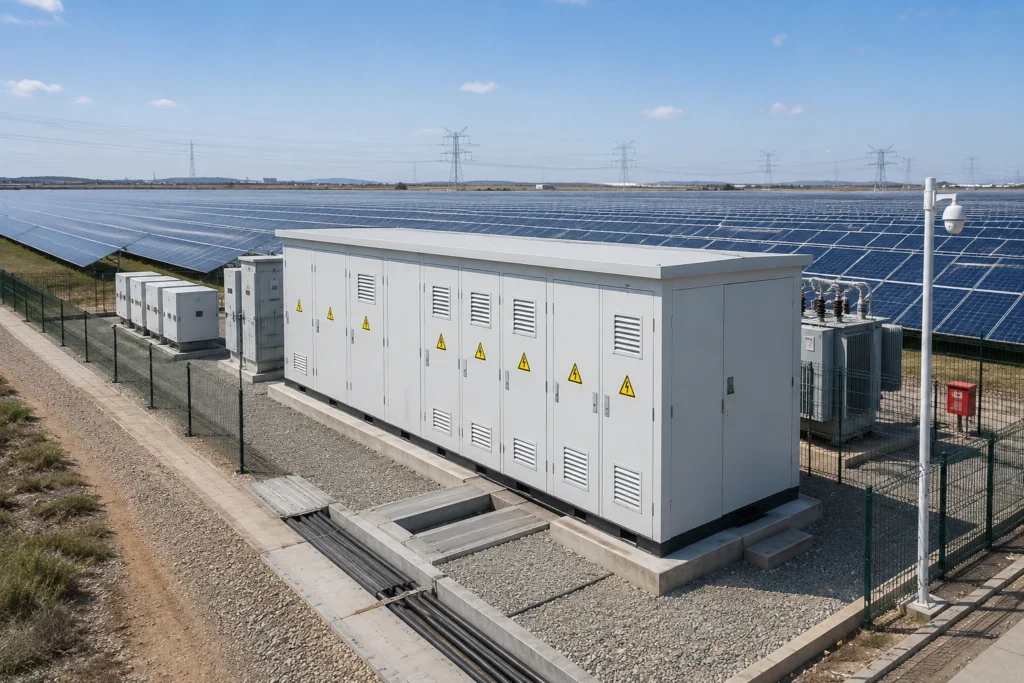
Solar Prefabricated Substation
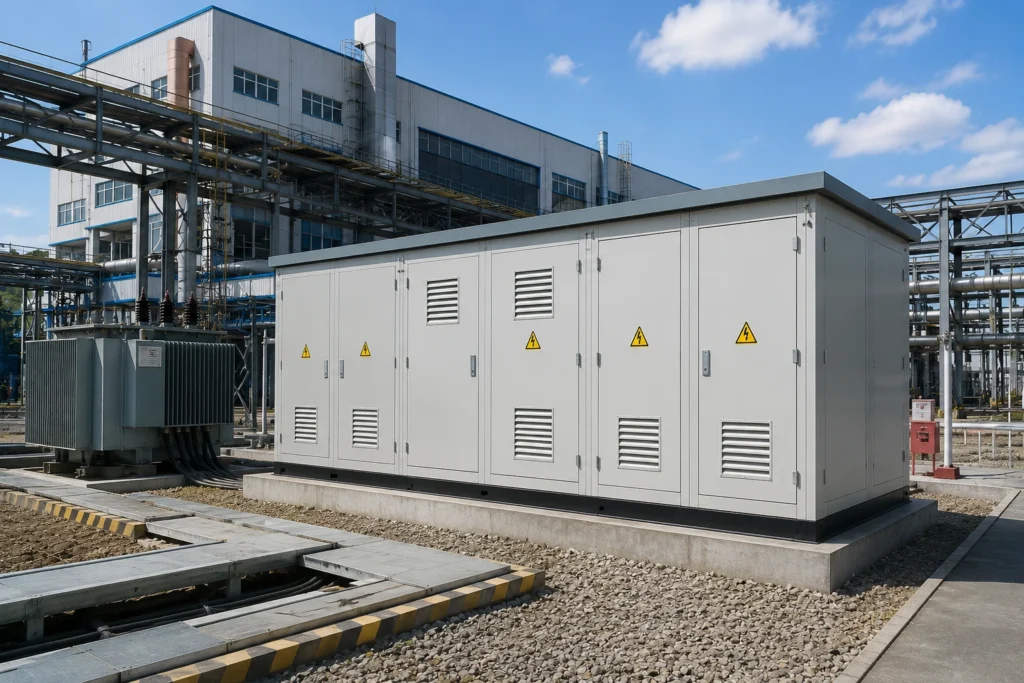
Industrial Prefabricated Substation

Utility Prefabricated Substation
Core Components & Layout
A standard prefabricated substation is typically organized into distinct, physically separated compartments to ensure operational safety and system reliability:
High-Voltage (HV) Compartment: Contains HV switchgear, load break switches, or Ring Main Units (RMU) to manage incoming transmission/distribution lines and provide primary circuit protection.
Transformer Compartment: Houses dry-type or oil-immersed transformers that step down high voltages (e.g., $10\text{ kV} – 35\text{ kV}$) to low-voltage distribution levels (e.g., $400\text{ V} / 230\text{ V}$).
Low-Voltage (LV) Compartment: Houses LV circuit breakers, energy metering units, distribution panels, and power factor correction capacitors for local load distribution.
Enclosure & Auxiliary Systems: Built with heavy-duty materials (such as stainless steel, aluminum-zinc alloy, or precast concrete) equipped with thermal insulation, forced ventilation, fire suppression, and smart monitoring devices.
Key Advantages
Rapid Deployment: Reduces total project execution time by 60%–80% due to parallel factory manufacturing and minimal on-site civil works.
High Quality & Reliability: Assembled and tested under strict factory quality control standards, significantly lowering the risk of on-site wiring or component errors.
Footprint Efficiency: Highly compact design optimizes land usage, making it ideal for urban areas or sites with space constraints.
Enhanced Safety: Completely enclosed structure prevents accidental human contact with live parts and offers superior protection against environmental hazards (dust, rain, salt spray, and extreme temperatures).
Flexibility & Scalability: Designed as modular units that can be easily expanded, upgraded, or relocated as power demands evolve.
Typical Applications
Renewable Energy Infrastructure: Solar PV plants, wind farms, and battery energy storage systems (BESS).
Industrial & Mining: Mining sites, chemical plants, and heavy manufacturing facilities requiring quick grid connections.
Infrastructure & Transportation: Data centers, airports, high-speed railways, and EV charging hubs.
Urban & Commercial Development: High-density residential neighborhoods, commercial complexes, and municipal power grid upgrades.