Custom vs. Standard Transformers: Engineering Trade-offs, Price, and Lead Time Differences
How off-the-shelf and purpose-built transformers really differ — in design freedom, cost, and how long you wait — and how to choose without overpaying or over-waiting.
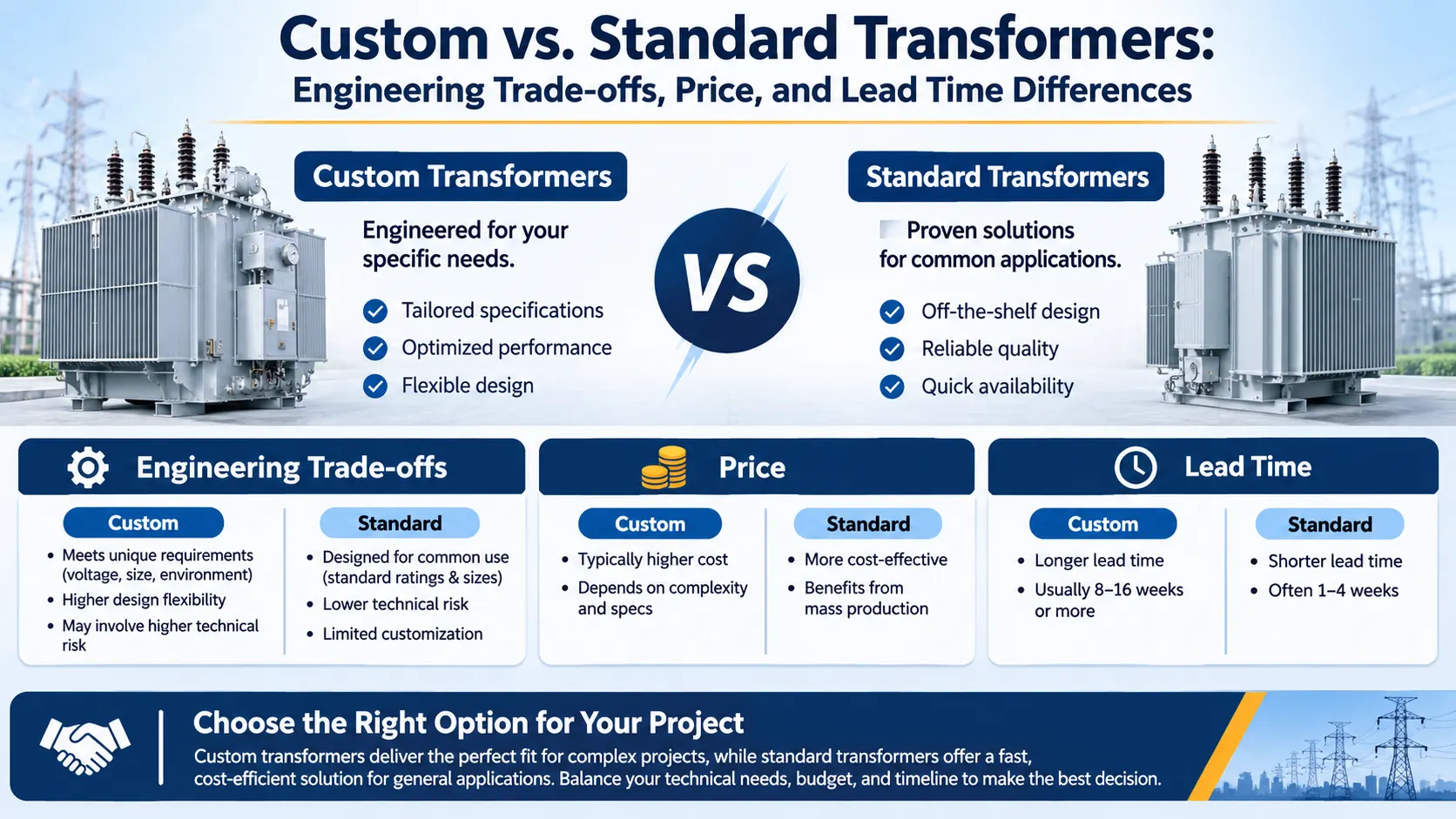
A standard transformer is built to a fixed catalogue specification and is ready to ship or produced on a short cycle, which makes it cheaper and faster. A custom transformer is engineered to your exact voltage, rating, footprint, cooling, and environment — it costs more and takes longer because it is designed and built for one job. Choose standard when your requirement fits a common rating and site; choose custom when voltage, space, climate, load profile, or compliance fall outside what a catalogue unit can safely cover.
What "standard" and "custom" actually mean
A standard transformer is a catalogue product. The manufacturer has fixed its voltage class, rating steps, cooling type, tank, and fittings in advance, usually to serve the most common distribution and industrial needs. Because the design already exists and the parts are stocked, a standard unit is either sitting in inventory or made on a short, repeatable production line.
A custom transformer starts from your requirement rather than a catalogue. The ratio, impedance, cooling method, enclosure, terminal layout, insulation class, and even the physical shape are engineered for a specific site, load, or regulation. Nothing about it is assumed — which is exactly why it costs and takes more, and also why it fits where a standard unit cannot.
The line between the two is not always sharp. A great deal of real-world ordering is a standard platform with a handful of modifications — a different tap range, a non-standard voltage, a tighter footprint. That middle ground is where most buyers actually sit, and knowing which way it leans is what controls budget and schedule.
Standard vs. custom at a glance
This table sums up how the two differ across the factors that drive a purchasing decision. Use it as a quick reference before reading the detail below.
| Фактор | Standard transformer | Custom transformer |
|---|---|---|
| Design basis | Fixed catalogue specification | Engineered to your exact requirement |
| Best fit | Common voltage, rating & site | Unusual voltage, space, climate or load |
| Relative price | Lower | Higher |
| Relative lead time | Shorter | Longer |
| Design flexibility | Limited to listed options | Full — ratio, impedance, cooling, shape |
| Footprint control | Whatever the catalogue size is | Built to the space available |
| Spare-part sourcing | Easy, interchangeable | Tied to the specific design |
| Efficiency tuning | Generic for the class | Optimised for your load profile |
Engineering trade-offs
The core trade is flexibility against predictability. A standard unit gives you a proven, repeatable design with known behaviour and easy spares, at the cost of accepting its fixed parameters. A custom unit gives you a transformer shaped to the job, at the cost of a longer design path and a one-off that has to prove itself.
Proven and repeatable
- Design already validated across many installs
- Interchangeable spares and quick replacement
- Predictable performance and documentation
- But: you adapt the site to the unit, not the reverse
- But: efficiency is generic, not tuned to your load
Shaped to the job
- Exact voltage, impedance and tap range
- Cooling and enclosure matched to the environment
- Footprint built for tight or awkward spaces
- Efficiency optimised for the real load profile
- But: longer design cycle and one-off spares
A few requirements almost always push a project toward custom engineering: a non-standard primary or secondary voltage; a harsh environment such as high ambient heat, coastal salt, high altitude, or heavy dust; a strict footprint where a catalogue tank simply will not fit; a load dominated by harmonics or frequent cycling; or a local standard and certification that a generic unit does not carry. When none of these apply, a standard unit usually wins on every practical measure.
Why the prices differ
The price gap is not a markup for the word "custom." It reflects real work that a catalogue unit has already absorbed and amortised across many identical builds. With a one-off, that work lands on a single order.
- Engineering and design. A custom unit carries its own calculation, modelling, and drawing effort, where a standard unit reuses a design that was paid for long ago.
- Materials and tooling. Non-standard cores, windings, tanks, or bushings may need special material runs or one-off tooling rather than stocked, high-volume parts.
- Testing and certification. A bespoke design often needs its own type tests and documentation, adding cost that a pre-certified catalogue unit avoids.
- No volume averaging. Standard transformers spread fixed costs across a production run; a single custom build cannot.
The practical takeaway is that modifications are not all equal. A small change within an existing platform adds little; a genuinely new voltage, core, or enclosure adds a lot. When budget matters, it is worth asking a manufacturer which of your requirements are cheap tweaks and which force a ground-up design.
Lead time differences
Lead time usually matters as much as price, and it is where the two paths diverge most sharply. A standard transformer skips the longest part of the process — design — because that work is already done. In many cases it is a stock item, so the "lead time" is essentially shipping and handling.
A custom transformer has to move through its full sequence before a single component is cut: requirement review, electrical and mechanical design, drawing approval, material procurement, build, then type testing. Each stage adds time, and the first one — getting the specification and drawings signed off — is often the longest and the easiest to underestimate. Specialised materials or bushings with their own supply lead time can stretch it further.
The order of magnitude is the point: a standard unit is typically a matter of availability and delivery, while a custom unit is a project measured from design approval onward. If a deadline is fixed, that difference should drive the decision as firmly as the budget does — and it is worth confirming the real schedule with the manufacturer early, not at the purchase order.
How to decide which you need
Run your requirement through a short set of questions. If every answer sits inside the catalogue, buy standard. The moment one answer falls outside it, custom engineering is on the table.
- Voltage & rating: Does a listed voltage class and rating step cover you, or do you need something in between?
- Space: Will a catalogue footprint fit the room, pad, or enclosure you actually have?
- Environment: Is the site ordinary, or does heat, salt, altitude, or dust exceed standard ratings?
- Load profile: Is the load clean and steady, or dominated by harmonics and cycling that reward a tuned design?
- Compliance: Does a standard unit already carry the local standard and certification you must meet?
- Schedule & budget: Can the project absorb the longer lead time and higher cost a custom build requires?
Most projects land in the middle — a standard platform with targeted modifications. The goal is not to default to either end, but to spend custom engineering only where the requirement genuinely earns it.
Match the transformer to the job with HAOCHENG
The cleanest way to avoid overpaying for custom work — or forcing a standard unit into a site it does not fit — is to size both options with the manufacturer before you commit. Shanghai Haocheng Electrical Equipment Co., Ltd. has built high- and low-voltage power equipment since 2010, from a 20,000 m² production base in Yueqing, Zhejiang, as a qualified core supplier to the State Grid Corporation of China. Its transformer range spans oil-immersed, dry-type, pad-mounted, compact-substation, solar-box, and inverter-duty units, all built to IEC and GB standards — which means a catalogue platform and a fully engineered build can be weighed side by side under one roof.
HAOCHENG's global service covers specification review, custom electrical and mechanical design, standard-unit supply for common ratings, and in-house type testing — supporting projects already running in Saudi Arabia, Vietnam, Europe, North America, and China. Whether a requirement fits a catalogue unit or needs a purpose-built design, the engineering team can confirm the right path, the real price driver, and the honest lead time before an order is placed.
Поговорите с инженером компании HAOCHENG, специализирующимся на трансформаторах →
Контакт: shhacn@haochengcompany.com · +86 159 5190 9762 · № 3777 Tingwei Road, район Цзиньшань, Шанхай, Китай
Часто задаваемые вопросы
What is the main difference between a custom and a standard transformer?
A standard transformer is built to a fixed catalogue specification for common needs, so it is cheaper and available faster. A custom transformer is engineered to an exact voltage, rating, footprint, cooling method, and environment, so it costs more and takes longer but fits requirements a catalogue unit cannot safely cover.
Why does a custom transformer cost more than a standard one?
The higher price reflects real one-off work: dedicated engineering and design, special materials or tooling, and its own type testing and certification. A standard transformer spreads those fixed costs across many identical builds, while a custom unit carries them on a single order. Small modifications to an existing platform add little; a genuinely new voltage, core, or enclosure adds the most.
How much longer is the lead time for a custom transformer?
A standard transformer is often a stock or short-cycle item, so its lead time is mainly delivery. A custom transformer must pass through requirement review, design, drawing approval, material procurement, build, and testing before shipping. The design-approval stage is usually the longest, and specialised materials can extend it further, so a custom unit should be treated as a scheduled project rather than an off-the-shelf purchase.
When should I choose a custom transformer instead of a standard one?
Choose custom when the requirement falls outside the catalogue: a non-standard voltage or rating, a tight or awkward footprint, a harsh environment such as high heat, salt, altitude, or dust, a load dominated by harmonics or cycling, or a local standard a generic unit does not carry. If every requirement fits a listed option, a standard unit is usually the better choice on both cost and schedule.
Can a standard transformer be modified instead of going fully custom?
Yes, and it is the most common real-world path. Many orders are a standard platform with targeted changes such as a different tap range, a non-standard voltage, or a tighter footprint. This often costs and takes far less than a ground-up custom design, so it is worth asking the manufacturer which requirements are minor modifications and which force a full custom build.